
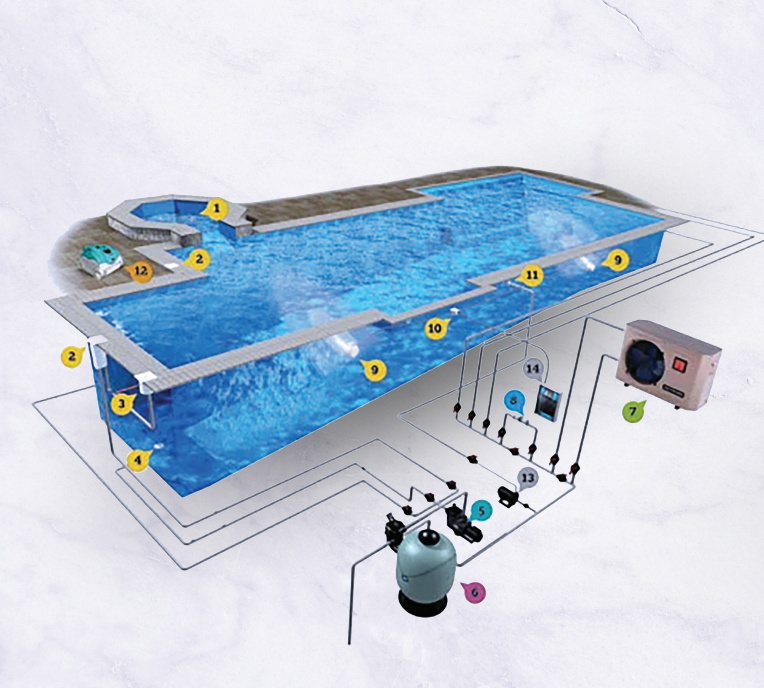
Behind every smoothly running pool is a hydraulic system most homeowners never see. While the tiles, coping, and water features get all the attention, it’s the plumbing and equipment layout, mapped out in a hydraulic schematic, that determines how well a pool actually performs day to day. Understanding the basics of pool hydraulics helps homeowners ask better questions and appreciate why proper planning matters just as much as design.
What Is a Hydraulic Schematic?
A hydraulic schematic is essentially the blueprint for how water moves through a pool system. It maps out every pipe, valve, skimmer, drain, and piece of equipment, showing how water is drawn out of the pool, filtered, treated, heated if applicable, and returned. A well-designed schematic ensures water circulates efficiently throughout the entire pool, avoiding “dead spots” where water sits stagnant and debris or algae can build up.
The Core Components
Skimmers and drains. Water enters the circulation system primarily through skimmers, which collect surface debris, and main drains at the pool’s lowest point, which help pull water from the bottom. Balancing suction between these two points is a key part of good hydraulic design.
Pump. The pump is the heart of the system, drawing water from the skimmers and drains and pushing it through the filtration and treatment equipment before returning it to the pool. Correct pump sizing is critical; too small and circulation suffers, too large and you waste energy and stress the system unnecessarily.
Filter. Water passes through a filter, typically sand, cartridge, or diatomaceous earth, to remove particles before it’s returned to the pool. The schematic determines where the filter sits in the sequence and how it connects to the rest of the equipment.
Heater and sanitisation equipment. For pools with heating or automated chlorination, the schematic shows where these components sit in the water’s path, ensuring treated or heated water is properly mixed before returning to the pool rather than short-circuiting the system.
Return jets. Finally, filtered water re-enters the pool through return jets, positioned and angled to promote even circulation across the entire pool rather than clustering flow in one area.
Why Proper Hydraulic Design Matters
Poorly planned hydraulics can lead to weak circulation, uneven water temperature, higher energy costs from oversized or undersized pumps, and even long-term equipment strain. On more complex builds, such as pools with spas, water features, or multiple levels, hydraulic planning becomes even more critical to ensure every component receives adequate flow without overloading the system.
What This Means for Homeowners
You don’t need to understand every technical detail of pipe sizing or flow rates, but it’s worth knowing that hydraulic planning happens well before a single tile is laid. Ask your builder how they approach circulation design for your specific pool shape and features, particularly if you’re including a spa, water feature, or an unusually shaped pool.
Sunset Pools: Getting the Fundamentals Right
At Sunset Pools, every project starts with careful hydraulic planning, ensuring efficient circulation, balanced equipment sizing, and a system built to perform reliably for years to come.
Contact Sunset Pools today to discuss your project and see how proper planning shapes every pool we build.